Frequently Asked Questions
General
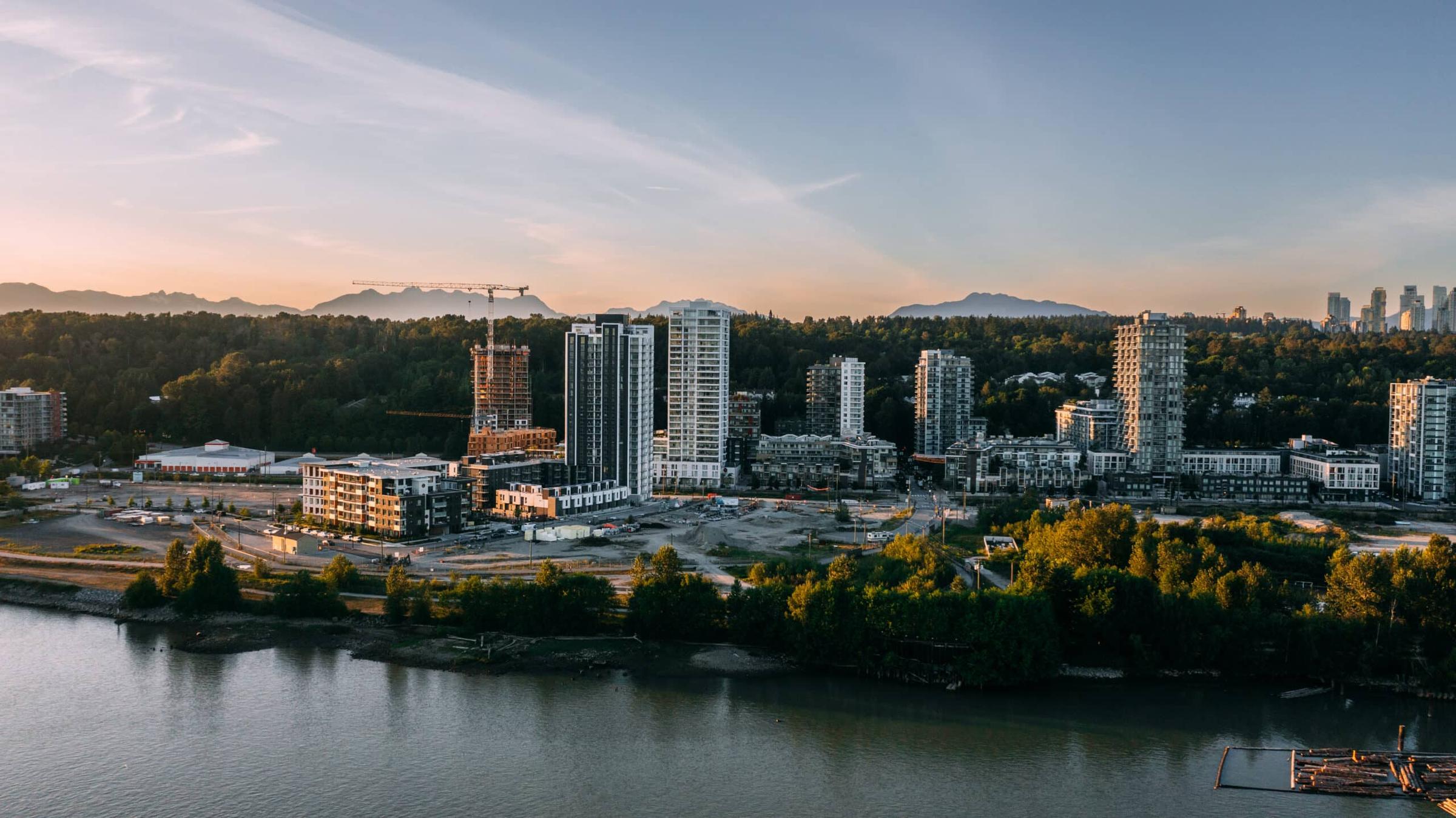
River District is a large-scale, master-planned community that will continue to evolve over time. As with many projects of this scale, development is phased to align with market conditions, and community needs.
Based on current planning, full buildout is anticipated to be completed within the next 20 years. This long-term horizon allows for steady delivery of housing, amenities, public spaces, and local services, supporting a complete and vibrant community as it grows.
While future transit improvements may help reduce reliance on vehicles over time, current market expectations and City requirements still call for a meaningful amount of parking to support residents and local businesses today.
Wesgroup is exploring opportunities to locate parking above grade on its remaining parcels as a way to support efficient construction and keep projects moving forward. By reducing the amount of underground excavation required, this approach reduces construction complexity and costs, to support continued masterplan delivery, including housing, amenities, and community-serving spaces envisioned for River District.
Each parcel will continue to be evaluated individually, with above-grade parking considered where it can be integrated thoughtfully into the building design. In these locations, the building footprints allow parking levels to be fully internalized, maintaining active frontages and a walkable streetscape along surrounding roads and public spaces.
River District was designed with a substantial amount of underground parking to support residents, visitors, and businesses. In fact, overall parking supply in the community exceeds the minimum requirements set by the City of Vancouver. This provides flexibility and helps meet current mobility needs while the area continues to grow.
Underground parking is available throughout the community, including within River District and the River District Town Centre. We encourage residents and visitors to make use of these underground facilities, which are designed to provide convenient access while helping keep streets and surface areas welcoming and pedestrian-friendly.
If you would like to receive planning and engagement updates from Wesgroup, please email us at info@eastfraserlands.ca to be added to our mailing list.
Community Centre
Wesgroup is responsible for constructing roads and utilities, providing the City with serviced sites for public amenities, while also contributing Community Amenity Contributions (CACs) and Development Cost Levys (DCLs) to fund those amenities. Since 2022, Wesgroup is also responsible for building and delivering the community centre. The City is responsible for delivering public amenities such as parks, childcare, affordable housing, and schools using the funds collected from development contributions and other available funding sources.
The community centre was originally planned as a 36,000-square-foot facility with an estimated cost of $47 million when Wesgroup took on this obligation in 2022.
Yes. From the outset of the master plan in 2010, there was a $25M funding gap identified by the City in the amenity delivery strategy, with strategies proposed to mitigate long term financial challenges. By 2017, this gap had increased to $48M, and by 2021, this gap was identified as $51M.
The alternative community centre delivery framework approved in 2022 was an attempt by the City and Wesgroup to improve delivery within an already constrained financial framework. The framework combined a $16M CAC associated with additional Area 1 density (generated through future redevelopment), $9M in previously collected EFL CACs, and $22M in costs associated with removing EFL from the Utilities DCL boundary.
Metro Vancouver’s DCC increase in fees added over $52M in additional costs to River District, including $14M specifically added to Area 1, significantly eroding the value available to support the delivery of amenities, particularly for the community centre and redirecting those funds to regional infrastructure.
In 2022,Wesgrouptook over the obligation to build and deliver the community centre. The City was responsible for costs associated with material scope changes.
Following Council approval, Wesgroup assembled a full consultant team and began detailed work with City and Park Board staff. The 2022 financial framework established a budget and area basis for the community centre, but the detailed functional program and room-by-room requirements still had to be worked through. The team advanced site planning, parking, access, loading, childcare integration, waterfront connections, servicing, sustainability and building systems through a collaborative Preliminary Development Permit process.
By 2023, as the functional program was translated into a detailed design, the area required for individual spaces and supporting building functions increased relative to the original planning assumptions. In other words, the size of the community centre and requirements increased, adding significant costs.
Working through the Functional Program and design development was a process that took over 18 months, ultimately culminating in a Development Permit application in 2024.
From 2022 through 2024, Wesgroup, the City and Park Board repeatedly tested ways to reduce cost and area while keeping the main program intact.
The result was not a lack of activity, but a sustained effort to reconcile a more fully developed functional program experiencing generational cost escalation while preserving the core community centre scope.
To date, Wesgroup has spent ~2.25M on direct community centre design costs.
After the 2022 transfer of the community centre was approved, Wesgroup assembled a consultant team and began working on the design in collaboration with the City and Park Board.
Two significant changes occurred following approval in 2022:
First, Metro Vancouver implemented an unprecedented increase in DCCs, adding an estimated $52 million in costs across River District, including $14 million attributed to Area 1 alone. This additional cost redirected funds that could have supported the community centre toward regional infrastructure instead.
Second, as detailed design progressed and the functional program was translated into an actual building, estimated community centre construction costs increased from approximately $47 million to approximately $65 million.
The combined effect was approximately $70 million in additional costs relative to the assumptions that supported the 2022 delivery framework.
The 2022 Waterfront Precinct rezoning included an approximately $16 million in-kind CAC contribution associated with the additional development density in Area 1. To date, none of the parcels associated with this additional density have been developed or pre-sold. As a result, the development value contemplated when the framework was established has not yet been realized.
At the same time, approximately $14 million in additional Metro Vancouver DCCs were attributed to Area 1, meaning a significant portion of the value intended to be generated through redevelopment and used to support local amenities is instead being directed toward regional infrastructure.
Changing who delivers the community centre would not, on its own, solve the funding gap.
The money available to build major public amenities at River District comes largely from development as new homes and buildings are constructed. When development slows, that funding is delayed as well. The challenge is not simply who builds the community centre; it is making sure there is enough money available to pay for it. A City-led approach would face the same funding challenge if the expected development revenues had not materialized.
Yes. The Community Centre is one component of a broader public-benefit package that includes parks, childcare, affordable housing, shoreline improvements and school sites. City capital plans have allocated funding toward new and expanded parks, including the Kinross Parks, Promontory Park and Foreshore Park. The planning framework also includes a 74-space childcare facility associated with the community centre and requires at least 20% of residential units to be available for affordable housing. Wesgroup was also successful in delivering additional childcare, outside of the negotiated public benefits package through a commercial arrangement with Willowbrae Childcare Academy, which today accommodates 160 children. In addition, every Wesgroup building at River District includes dedicated indoor and outdoor amenity spaces for its residents.
To help ensure continual development and support for amenity delivery at River District, Wesgroup proposed amendments to the plan for Area 1 in 2025, to bring parking above-ground. These zoning amendments were approved in February 2026. Metro Vancouver also approved short-term DCC relief for 2026 and 2027, although the longer-term cost environment remains uncertain.
Wesgroup and the City continue to work on a viable funding and delivery solution, including potential public funding, alternative financing/delivery concepts and possible future Area 3 revenue opportunities. The community centre remains an active commitment, but the funding and development conditions are materially different from those underlying the 2022 Council-approved framework.